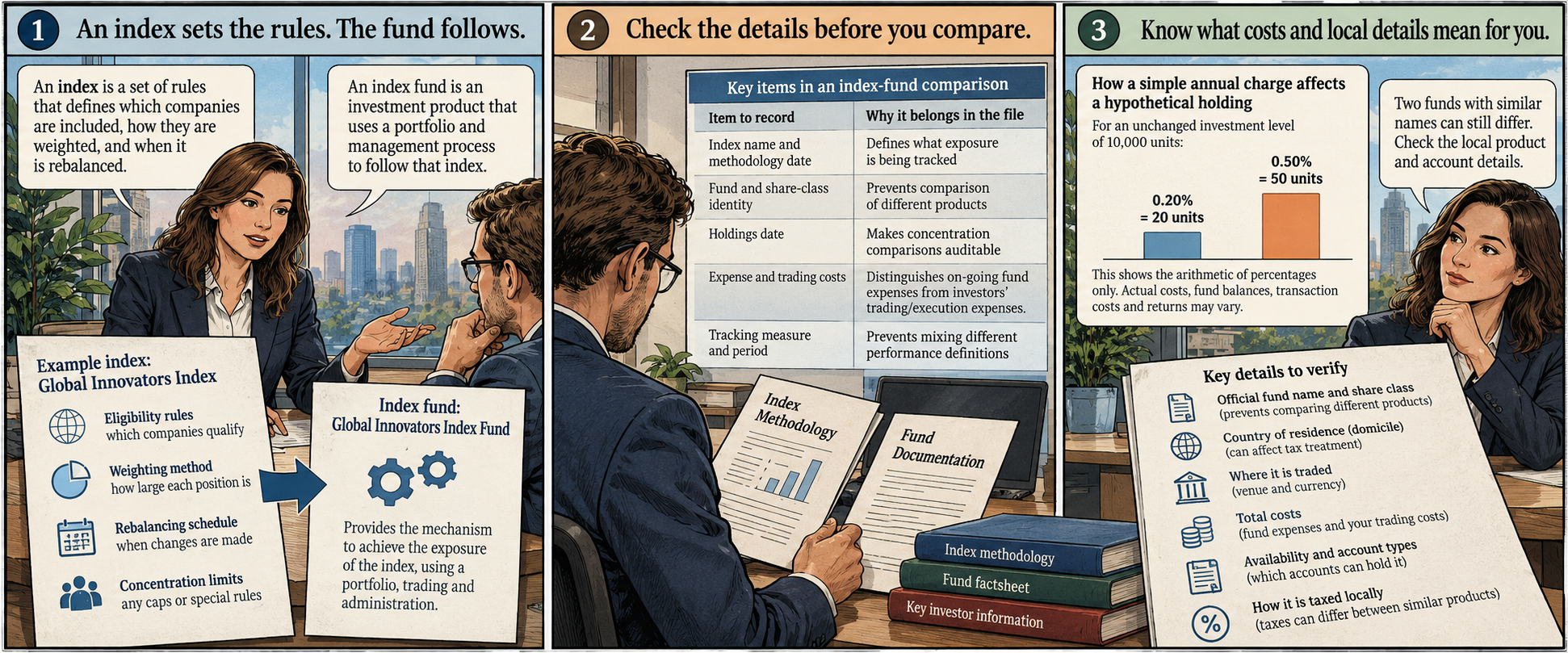
What is the difference between an index and an index fund?
Start by giving the index a name. Using a general market label may hide important distinctions regarding eligibility, weighting, rebalancing, and concentration. Then, give the fund's official name, share class, country of residence (domicile), where it is traded (venue), and currency. A single ticker is not enough to describe the product completely.
Which fields belong in an index-fund comparison?
[Table]
Item to record | Why it belongs in the file
Index name and methodology date | Defines what exposure is being tracked
Fund and share-class identity | Prevents comparison of different products
Holdings date | Makes concentration comparisons auditable
Expense and Trading Costs – Distinguishes on-going fund expenses from investors' trading/execution expenses.
Tracking measure and period | Prevents mixing different performance definitions
[End table]
How do different fund costs affect a hypothetical holding?
For an arbitrary unchanged investment level of 10,000 units, the use of a simple annual charge of 0.20% represents 20 units and a 0.50% represents 50. The purpose here is to isolate the arithmetic of percentages. However, this is not a complete fund cost model, as actual fund balance amounts, the mechanics used to apply the charges, transaction costs, and returns may vary.
Which local product and account details must investors verify?
Two different products, each tracking a similarly-named index, will often differ as to how much they are available, what taxes apply to them and which types of accounts they may be held within in both Canada and the UK. To determine these factors for each product requires obtaining current information from the issuer of the product as well as locally. Do not assume that a US based fund is able to be purchased into a specific type of account simply because the fund's ticker was found in a search export.
What makes a useful research conclusion?
Please provide me with the question you are asking so I may explain the exposure and trade-offs that are important to your question. I will not rank funds based on their fees alone, nor will I guarantee any return from the use of an index methodology. The source-linked comparison provided should still be relevant to users as products update their data in the future.
What other questions do readers ask?
What is the difference between an index and an index fund?
To begin with, name the index that will be used to track the fund. Be careful when selecting a general market index as it may have different eligibility criteria, weightings, rebalancing procedures, and concentration limits than those that are applicable to your specific fund. Next, list the official name of the fund; share class; country of registration (domicile); where the fund is traded (trading venue); and currency of trading. Listing just the fund's ticker is not sufficient to fully describe the product.
Which fields belong in an index-fund comparison?
[Table]
Item to record | Why it belongs in the file
Index name and methodology date | Defines what exposure is being tracked
Fund and share-class identity | Prevents comparison of different products
Holdings date | Makes concentration comparisons auditable
Expense & Trading Costs: Splits on-going fund charges from investor execution costs
Tracking measure and period | Prevents mixing different performance definitions
[End table]
How do different fund costs affect a hypothetical holding?
If we assume that the amount of money invested (i.e., $10,000) will remain constant throughout the year, then the simple annual charge of 0.20 percent would equal $20 and the simple annual charge of 0.50 percent would equal $50. This demonstrates how to isolate the percentage arithmetic. However, this is not an accurate fund-cost model. Real-world balances, charge structures, transaction costs and returns can all vary.
What are the limitations of this guide?
This is an educational research paper that will be reviewed by people. This document does not give you personal advice, nor does it guarantee that something will happen. Before you publish your reference materials, make sure they are checked against what you said in your statement; hypotheticals cannot be used as source data.